


What a good chicken coop looks like in the eyes of a chicken
- Leo liu
- Apr 24
- 9 min read


As an experienced resident who has seen much of the world—a seasoned hen that has lived in leaky shacks and even in a so-called "five-star chicken coop" —I now represent the chicken industry and will seriously explain to all of you what kind of coop truly deserves the title of "qualified ."
Although chickens cannot speak, they vote through their actions: if the living conditions are unsatisfactory, we collectively abandon egg production; if satisfactory, we lay double-yolked eggs daily. The following six criteria constitute the "hard requirements" for the poultry house, none of which may be omitted.
Article 1: Dry, dry, and dry again!
What does a chicken fear most in its lifetime? Not weasels, nor eagles, but moisture. This can be understood as follows: our feathers appear fluffy and insulating, but they are completely impermeable to water. If the chicken coop is damp throughout and the bedding can wring out water, we are essentially immersed in cold water day and night—our claws will rot, our joints will ache, our feathers will remain permanently sticky, and we will lack the strength even to flap our wings in the chicken coop.
More alarmingly, humidity serves as a "super accelerator" for pathogens and odors. Coccidia, Escherichia coli, and Salmonella present in damp chicken manure proliferate rapidly. When ammonia concentrations rise significantly, even stepping inside the chicken coop would cause tears to stream down one's face, especially considering that the chickens must spend nights there—a scenario akin to a chronic gas chamber. Therefore, the foremost iron rule for a properly designed poultry house is: maintain dryness.
What constitutes a dry surface? Take a handful of the ground bedding material (wood chips, straw, or rice husks will do) and squeeze it firmly; your palm should show no moisture. The floor must be free of standing water—even if a water bowl is accidentally overturned, the water should drain or evaporate quickly. The optimal design involves a raised floor: chickens stand on wooden planks or plastic grates, allowing manure to flow directly beneath them, keeping their feet always clean. If a raised floor of the chicken coop is not feasible, the bedding should be replaced frequently, and special attention must be paid to ventilation and dehumidification during rainy weather.
The dry chicken coop eliminates any pungent ammonia odor upon entry, allowing chickens to enter in a relaxed state and even leap onto the perches with greater enthusiasm. To be frank: a coop capable of producing water through拧ling is suitable only for raising ducks, not chickens.
Article 2: Adequate ventilation is essential, but excessive airflow should be avoided. Dryness and ventilation are closely interconnected. In a chicken coop with poor air circulation, ammonia, carbon dioxide, and water vapor accumulate indoors, rapidly creating a stifling environment. Standing inside for just three minutes can cause red eyes and a tight throat—these are early signs of ammonia poisoning. The respiratory tracts of chickens are far more vulnerable than those of humans; prolonged exposure to such conditions can lead to chronic respiratory diseases, characterized by coughing, nasal discharge, and orbital swelling, ultimately resulting in infertility.
However, ventilation does not necessarily mean opening windows as wide as possible. In winter, if a cold wind blows directly onto the chickens "stealthily," the situation is even worse than being confined indoors. Chickens are most vulnerable to crosswind—linear cold air currents entering from one end and exiting from the other. Chickens exposed to direct wind exposure may experience mild symptoms such as colds and sneezing, or severe conditions like diarrhea and decreased body temperature; particularly young chicks and laying hens can collapse immediately upon exposure.
A properly designed poultry house must ensure uniform, gentle, and adjustable ventilation. During hot summers, all windows and roller shutters should be opened to allow natural air circulation, which removes heat and moisture. In cold winters, only the top exhaust vents or small gaps beneath the eaves should be opened—since ammonia is lighter than air and rises upward, escaping from higher areas while preventing cold air from directly contacting the chickens. If you observe chickens in the house huddling together with their necks tucked in during winter or breathing heavily with open mouths and extended tongues in summer, this indicates improper ventilation and temperature control.
The simplest diagnostic method in the chicken coop is as follows: Enter the poultry house, bend forward and squat down, then inhale the air layer where the chickens are active. If no noticeable foul odor is detected, the ventilation is adequate; if the chickens attempt to escape upon entry, immediately open the windows of the chicken coop.
Article 3: Warm in winter and cool in summer, chickens also have a "comfort zone." The optimal temperature range for chickens is between 15°C and 25°C. Within this range, they eat efficiently, sleep soundly, lay eggs prolifically, and maintain lustrous feathers. Beyond this range, each degree exceeds their physiological limits.
What happens when it's too cold? In winter, if you observe chicks hunching their necks, with their feathers like small spheres, standing on one leg and unwilling to move, this is their way of signaling "it's too cold." Cold causes them to expend a significant amount of feed to generate heat; their growth rate slows, egg production decreases, and even their combs and toes may turn black or freeze off. When the temperature falls below 30°C, the chicks huddle together for warmth, with those below being crushed to death and those above freezing to death—a truly heartbreaking sight.
What happens in the chicken coop when it's too hot? Chickens lack sweat glands and rely solely on mouth breathing and wing flapping for heat dissipation. During summer high temperatures, you may observe a flock of chickens exhibiting collective "dog-like panting respiration," with drooping wings and vacant eyes. As body temperature rises, their feed intake decreases, eggshells become thinner, and egg yolks lose their color; in severe cases, they may die from heat stress in the chicken coop. This is particularly true for laying hens: when temperatures exceed 32°C, they cease laying—not because they stop laying altogether, but because they are unable to produce eggs.
A properly designed poultry house must be capable of handling both extreme conditions. What provides protection in winter? Insulated walls—thick wooden panels, brick walls with interlayers, and roof insulation; a south-facing orientation to allow winter sunlight penetration; and minimized gaps to prevent cold air infiltration. During winter, an insulation lamp or a fermentation bed can generate heat indoors in the chicken coop, but coal stoves must never be used (carbon monoxide is lethal to chickens).
What provides cooling in summer? It relies on shade—having a large tree next to the chicken coop is ideal; if not, install a shade net. It also utilizes roof reflectivity by applying white paint or installing reflective film. Natural ventilation combined with fan assistance is effective, and misting under the eaves can help reduce temperature (be careful not to spray it onto the bedding, as this would cause moisture). A classic, simple method involves laying a layer of wet straw on the roof; the evaporation process absorbs heat and lowers the temperature by several degrees.
In simple terms: in winter you won't feel cold inside the chicken coop, and in summer you won't feel stuffy—it's a perfect chicken coop.
Article 4: Protection Against Natural Predators – Weasels, rats, wild cats, and snakes: Not a single one should ever enter. This rule is often underestimated by predators. During the day, when you monitor the chicken coop, it seems quite secure; but at night, our chickens are completely blind – once it gets dark, we can see nothing. If a predator sneaks in during this time, we don't even know where to run; we can't fly high, and we're left with no choice but to wait for death.
The weasel is the number one killer. This slender creature can burrow through holes the size of a fist; it can also unlock doors, bite through wood, and squeeze in through roof tiles. More terrifyingly, when hunting chickens, a weasel doesn't kill them all—it kills dozens but takes only one. The next threat comes from rats: although they don't directly attack adult chickens in the coop, they steal feed, bite chicks, spread diseases, and even dig holes in walls to create entry points for weasels. Wild cats, stray dogs, and even neighbors' dogs pose potential dangers. If eagles frequently appear over free-range areas, even daytime becomes unsafe.
A qualified poultry house must possess impregnable defenses against natural predators. How is this achieved specifically?
There are no openings larger than 1 cm in walls or floors. Since rats can burrow through gaps as small as a coin, all such gaps must be completely sealed.
The door of the chicken coop must be sturdy, preferably equipped with a dual security system combining a latch and a buckle. Always lock the door at night; do not consider it troublesome. Some weasels may mimic human movements when opening the door, and they can indeed force it open without your intervention.
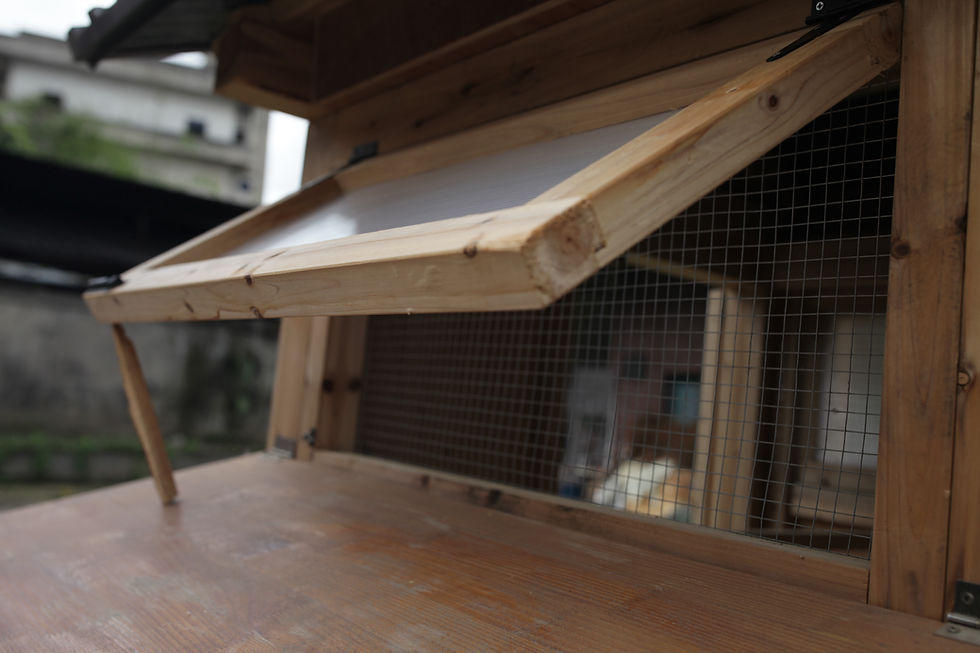
Windows and ventilation openings shall be fitted with wire mesh, with mesh openings no larger than 1.5 cm. Plastic mesh should not be used, as it breaks easily upon being bitten by weasels.
Do not pile up miscellaneous items or firewood around the chicken coop, as it serves as a habitat for rats and snakes.
If the free-range area poses significant risks, additional eagle-proof nets—such as nylon nets or fishing line nets—can be installed at a height of two to three meters above the ground.
You might ask: If I seal the chicken coop tightly, will the chickens suffocate? Rest assured, as long as there are ventilation openings, air can circulate. Protection against predators and ventilation are not contradictory—the installation of an iron mesh screen on these openings allows air intake while preventing weasels from entering.
A properly designed poultry house ensures that chickens are absolutely safe inside after the doors are closed at night. No matter how cunning a weasel may be, it can only circle outside, drooling at the scent of chickens but failing to penetrate the premises. Upon opening the doors the next morning, the chickens in the coop are present in full number—this constitutes the greatest sense of accomplishment.
Article 5: All essential "furniture" must be included. Chickens are not intelligent creatures that stand idly staring blankly. They possess innate instincts, behavioral habits, and social needs. A properly designed poultry house cannot merely be an empty rectangular box; it must be equipped with essential components. Otherwise, chaos will ensue.
The first item: Perches. Chickens naturally sleep in elevated positions. In the wild, they seek branches or elevated rocks at night to avoid snakes and moisture on the ground. Therefore, a chicken coop must contain one or more wooden poles, positioned 30 to 50 centimeters above the ground with smooth surfaces free of splinters. Each chicken requires approximately 15 to 20 centimeters of perch space—meaning a coop for ten chickens should have a total perch length of at least two meters. Perches should be arranged at varying heights, with dominant chickens occupying higher positions and weaker ones lower ones to minimize fighting. Without perches, chickens are forced to sleep on damp ground, increasing their susceptibility to illness, trampling injuries, and feather contamination. In essence, perches serve as chickens' beds. Without beds, how can they sleep soundly?
The second item: an egg-laying box. A hen requires a concealed, quiet, and dimly lit compartment to lay eggs. You might wonder: Is there really such a need for such meticulous preparation? Let me tell you—it is absolutely essential. When laying eggs in broad daylight, a hen feels extremely uneasy—because the eggs are for future chicks, and eggs laid outdoors are easily spotted by predators. Therefore, hens seek out dark spots to lay their eggs: in the bushes, behind walls, or even in someone else's firewood pile. If you don't provide an egg-laying box, the hen will lay her eggs in an inconspicuous place in the chicken coop, and by the time you discover them, they will have already spoiled.
A proper laying box measures approximately 40 cm square, featuring a front panel or curtain with soft bedding of straw or wood chips inside. Each box should accommodate three to five hens and be positioned below the roosting rack—otherwise, the chickens will crouch inside while sleeping, filling the box with droppings. The box must remain dark and clean, ideally cleaned briefly after egg collection each evening. When a hen enters to lay eggs, you'll hear her satisfyactory "gurgling" sound, signaling: "This place is peaceful and undisturbed; I feel at ease." The third crucial element: feeders and water systems. Though seemingly simple, many poultry facilities fail here. Ground-mounted feeders encourage chickens to scratch, drag feces, and scatter feed everywhere, resulting in at least 30% waste. The optimal solution involves hanging feeders at shoulder height, forcing chickens to drink while lying back and preventing scratching. Alternatively, use feeder enclosures with only a head exposure area. Water management is paramount—chickens must never go without water, especially during summer. Water bowls or nipple drinkers must remain clean, with fresh water changed daily, free from moss or fecal contamination.
Fourth: Sand bath basin (highly recommended). Chickens do not bathe with water; they use sand instead. By rolling and wriggling in the dry sand, they distribute it into the gaps between their feathers, effectively eliminating parasites such as chicken lice and mites. Place an old tire or a shallow wooden box filled with clean river sand or construction sand (not sea sand) in a corner of the coop, and you'll observe the chickens lining up to roll in—the experience is even more enjoyable than a human spa treatment.
With these "furniture pieces," the chicken coop is no longer a cold warehouse but a fully functional home. Imagine living in a place without beds, toilets, or tables—every day would be...


Comments